Email us
Info@nernstcatering.com
Leave A Message
If you are interested in our products and want to know more details,please leave a message here,we will reply you as soon as we can.

Guangzhou Nernst Catering Equipment Co., Ltd., China
30 Years Commercial Kitchen Refrigeration Equipment Factory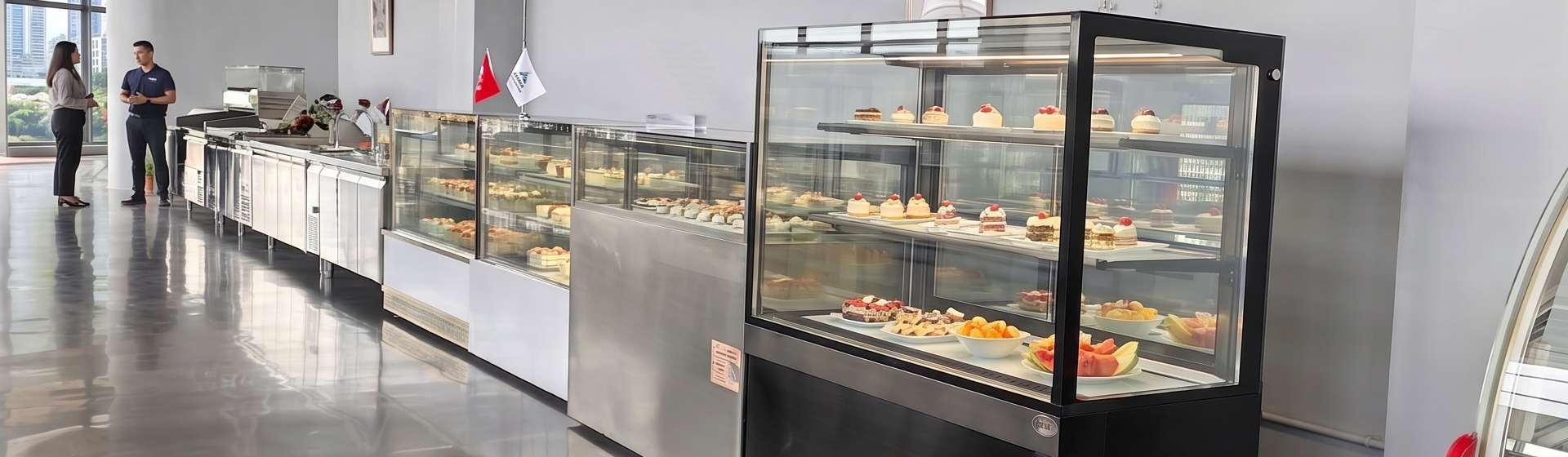

Commercial refrigerators have a significantly higher failure rate in coastal areas due to the compounding effects of heavy salt spray corrosion, high relative humidity, and sustained high-temperature, high-load operating conditions. These environmental factors progressively degrade the refrigeration circuit, electrical controls, insulation structure, and metal cabinetry.
Coastal ambient air contains high concentrations of airborne sodium chloride ($NaCl$) particles. Chloride ions have an extremely small ionic radius, allowing them to penetrate protective passive films on metal surfaces and initiate severe localized corrosion:
Pitting and Galvanic Breakdown of Condenser Aluminum Fins: Most commercial refrigerators use copper-tube, aluminum-fin condensers. Copper and aluminum have a large electrochemical potential difference. In humid, salt-laden moisture films, galvanic corrosion occurs rapidly. The aluminum acts as a sacrificial anode and disintegrates, causing the fins to crumble away. Subsequently, the exposed copper tubes suffer pitting and stress corrosion cracking, leading to refrigerant leakage (pinhole or capillary leaks).
Brazed Joint Failure: Pipe connections around the compressor discharge and suction lines are typically brazed using copper-phosphorus or silver alloys. Under salt-spray catalytic action, micro-pores in brazed joints oxidize, corrode, and peel apart, dumping the refrigerant charge and eventually causing compressor seizure from oil starvation.
Relative humidity in coastal regions consistently hovers between 75% and 95% or higher. Combined with airborne ionic salts, this severely impacts electrical systems:
PCB and Sensor Short Circuits: Salt spray settling on printed circuit boards absorbs moisture from the air, forming a conductive electrolyte layer. This causes a sharp drop in insulation resistance, electrical arcing, short circuits, or outright component burnouts. In addition, corroded terminals on temperature sensors and defrost probes drift in resistance value, triggering false defrost cycles or non-stop running.
Burnt Starting Relays and Contactors: Run/start capacitors, AC contactors, and PTC relays corrode and oxidize easily in humid, salty air. Increased contact resistance leads to overheating, pitted contacts, welding, or starting failures in the compressor.
Corroded Fan Motors: Both evaporator and condenser fan motors run continuously. Humid coastal air causes the bearings and motor stators to rust, seize, or burn out from overheating, which instantly triggers poor heat exchange and high-pressure trips.
Coastal tropical or subtropical maritime weather introduces massive thermal and latent moisture loads:
Restricted Condensation and High-Pressure Cutoffs: Once the condenser fins disintegrate or become fouled with salt crust and airborne grease, heat rejection plummets. Compressor discharge pressures and temperatures spike, forcing the unit to run in chronic overload conditions. This degrades and carbonizes the compressor oil, burning out windings over time.
Heavy Frost and Condensation from Frequent Door Openings: Hot, humid air rushes into the cabinet each time doors open. Moisture condenses instantly on evaporator coils to build dense frost layers, blocking airflow. This drops evaporation pressure, risks liquid floodback (slugging the compressor), and spikes electric defrost cycles and power consumption.
Degraded Gaskets and Insulation: Intense UV exposure and high humidity accelerate the hardening, cracking, and deformation of PVC magnetic gaskets, breaking the door seal. If water vapor penetrates the polyurethane cabinet insulation, moisture hydrolysis destroys the closed-cell foam, causing insulation performance to degrade permanently.
Many economy-grade commercial cabinets utilize 201 stainless steel (high manganese, low nickel content). While serviceable in dry inland environments, 201 fails quickly under marine conditions:
Surface pitting and dense, yellowish-brown rust spots develop quickly.
Door hinges, leveling legs, and cracks in vinyl-coated wire shelves rust or break, leading to door sagging, poor sealing, severe cold air loss, and spiked power usage.
We have developed products specifically for coastal/high-salinity regions.
| Critical Component | Standard Inland Spec | Coastal / High Salt-Spray Spec | Key Benefits |
| Condenser / Evaporator | Standard hydrophilic aluminum fins + copper tubes | Epoxy Gold Fin / Electrophoretic (E-coat) black coating / Pure copper micro-channel | Seals against salt moisture films; passes 1,000+ hour salt-spray tests; prevents refrigerant leaks |
| Control Board (PCB) | Bare board / minimal conformal coating | Full conformal coating (anti-moisture, anti-salt-spray, anti-mildew) or potted waterproof box | Blocks conductive water film formation; prevents circuit shorts and board burnouts |
| Cabinet Body & Interior | 201 stainless steel / powder-coated galvanized steel | Food-grade 304 stainless steel (resistant to chloride pitting) | Long-term resistance to salt corrosion; rust-free, hygienic, and easy to clean |
| Hardware & Fans | Galvanized steel hinges / stamped steel axial fans | Heavy-duty 304 stainless steel hinges / IP55+ sealed waterproof/corrosion-proof EC fans | Prevents door sag and prevents motor burnout from water ingress |
| Gaskets & Glass | Standard double-pane glass | Heated Low-E anti-condensation glass + widened heavy-duty anti-aging magnetic gaskets | Eliminates door sweating/water puddling and minimizes thermal leakage |
Scan to Whatsapp :

Scan to wechat :