Email us
Info@nernstcatering.com
Leave A Message
If you are interested in our products and want to know more details,please leave a message here,we will reply you as soon as we can.

Guangzhou Nernst Catering Equipment Co., Ltd., China
30 Years Commercial Kitchen Refrigeration Equipment Factory
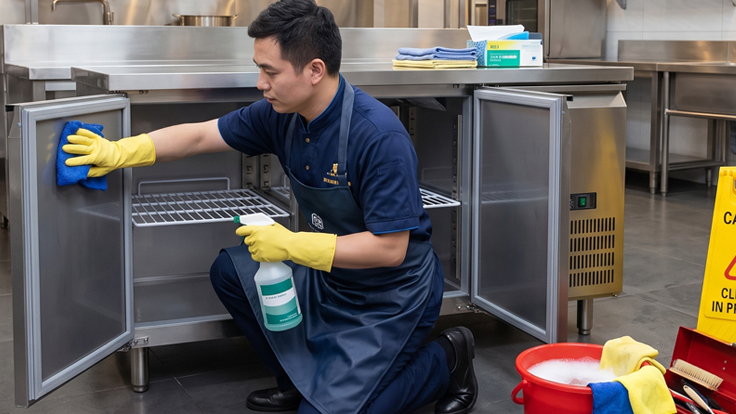
In coastal environments characterized by high salt mist and humidity, the primary goal of commercial refrigeration maintenance is to prevent salt scale caking and eliminate the formation of electrochemical corrosion media.
Power Disconnection & Safety Warning
Before performing any cleaning of the compressor compartment, inspecting the chassis, or servicing electrical components, always disconnect the power plug or switch off the dedicated circuit breaker. Never spray water directly into the compressor compartment, electrical control boxes, or fan motors with a high-pressure washer to prevent short circuits and electrical shock.
Grease vapor mixed with airborne salt mist readily forms a dense, corrosive crust on condenser coils.
Procedure: Apply a neutral coil cleaner and gently comb through the fins along their vertical grain using a soft-bristle brush. Rinse thoroughly using clean, warm water from a low-pressure spray bottle.
Verification: Inspect the gaps between fins against a backlight to ensure no sludge, white salt residue, or green patina remains. After startup, ensure the compressor discharge line warms up evenly without tripping high-pressure safety cut-outs.
Chloride ions in the air continuously attack the passive protective layer of stainless steel.
Procedure: Wipe the exterior body, rear panels, and joint seams with warm water and a neutral detergent (never use chlorine-based bleach or strong acidic/alkaline cleaners). Dry completely with a clean towel, then apply a thin coat of food-grade stainless steel protective polish.
Verification: Surface shows no dullness, white spotting, or yellowish-brown pitting corrosion, with no granular salt texture felt by hand.
Saline moisture tends to collect in gasket folds and around heated door frames, accelerating gasket embrittlement and cracking.
Procedure: Peel back the folds of the PVC door gaskets and clean out mildew and salt deposits with a damp cloth soaked in warm water. Clear the internal and external defrost drain holes and empty the evaporation pan to eliminate standing water.
Verification: Place a banknote between the door gasket and frame and close the door; if the note resists being pulled out and does not slide freely, the magnetic seal integrity is adequate.
Salt air causes contact resistance and mechanical binding on exposed fittings.
Procedure: Inspect the digital thermostat housing, compressor terminal junction box, leveling feet, and door hinges. Blow away loose dust and moisture from electrical terminals with dry compressed air. Lubricate hinge pivot pins, latch mechanisms, and leveling screws with food-grade grease or anti-rust wax.
Verification: Doors swing smoothly without squeaking or metal grinding; electrical terminals show no green copper corrosion (verdigris) or black heat-oxidation marks.
Strictly Avoid Chlorine-Based Cleaners: Disinfectants containing sodium hypochlorite, hypochlorous acid, or acidic hand soaps release free chloride ions that cause severe pitting, pinhole leaks, and irreversible staining on 201 and 304 stainless steel within days.
Never Use Abrasive Metal Tools: Do not scrub internal liners or condenser coils with steel wool or rigid scrapers; scratching the surface passivation film or protective coating accelerates core metal corrosion.
Airflow and Unit Placement: Keep the condenser air intake away from open coastal windows and raw seafood prep sinks. Maintain a clearance of at least 15–20 cm around the cabinet to ensure adequate heat dissipation and prevent moist air recirculation around the condensing unit.
Scan to Whatsapp :

Scan to wechat :